

Your medical textbook still explains brilliantly. What it can’t do is tell you which of its pages have moved, so here is a 10-minute check for your field.
15-minute read, 60-second version below · Sources checked 29 October 2026
Disclosure: This blog belongs to Elumity, a knowledge-map tool for medical specialties made by Byties AG, a self-funded start-up from the University of Bern. We mention Elumity once in passing, in one section and at the end; the 10-minute check works without it.
On Friday 28 August 2026, two definitions many doctors use every week were rewritten in a single day. The European Society of Cardiology’s 2026 heart-failure guidelines “eliminated the phenotype of HFmrEF”, the mildly reduced ejection-fraction category, so reduced ejection fraction now means anything below 50%.[1] Published the same day, the Fifth Universal Definition of Myocardial Infarction states that “the previous numerical classification of myocardial infarction has been replaced”: types 1, 2, 4 and 5 became primary, secondary and procedure-related MI, and type 3 was dropped.[2]
Picture a discharge letter dictated on the Thursday that said “HFmrEF” and “type 2 MI”: by Friday, the new documents had retired both labels. Nothing about the patients changed, and the physiology chapter in your medical textbook is as good as ever. Mostly the labels moved, though some treatment recommendations moved with them, and your letter templates and pocket cards didn’t move at all. But labels decide which part of a guideline you open, which trials you think apply and what goes into the discharge letter, so a label is never just a word.
“Paper textbooks are so yesterday,” people like to say at this point. That’s the wrong diagnosis. Medical textbooks are outdated in places, not wrong: anatomy, physiology and most mechanisms age slowly, and a good chapter still teaches them well. What goes out of date is the volatile layer of classifications, thresholds and first-line choices, which changes between editions that appear every one to four years,[3][4] and the book can’t show you which of its pages have moved.
The 60-second version
- A textbook does three jobs: explain, say what’s current and hold your memory. Print still explains mechanisms well, but labels, thresholds and first-line choices move between editions, and a blank margin can’t show what you know.
- Change is routine. In one high-impact journal over a decade, 146 of 363 studies that tested an established practice found it no better than the alternative.[5]
- Nobody can read it all. PubMed added about 1.7 million records in 2025, roughly 4,700 a day.[6]
- Questions outpace answers. In pooled, mostly older studies, clinicians raised about one question for every two patients, pursued about half and found answers to 78% of those, so only about four in ten were answered.[7]
- Do the 10-minute check. A pen, five topics, no sign-up.
- Training others or running a practice? Notes for departments, field teams and practices. Curious about the product? Where it fits, and where it doesn’t.
What changed from 2024 to 2026 while your textbook sat on the shelf?
Quite a lot, and mostly in the volatile layer: heart-failure categories, myocardial-infarction types, European blood-pressure categories, the first anti-amyloid antibodies authorised in the EU and valproate precautions for men. Each change below comes from the issuing body rather than a summary; three are from cardiology, which had a busy summer, and your own field will have its own list.
Pages that moved, 2024 to 2026
Checked 29 October 2026Heart failure (ESC, 28 Aug 2026)
Before
HFrEF, HFmrEF and HFpEF.
Now
HFmrEF is gone and HFrEF means LVEF below 50%; “decompensated” also replaces “acute” heart failure.[1]
Myocardial infarction (Fifth Universal Definition, 28 Aug 2026)
Before
Types 1 to 5.
Now
Primary, secondary and procedure-related MI, with type 3 dropped.[2]
Blood pressure (ESC, Aug 2024)
Before
Optimal, normal and high-normal.
Now
In the ESC guideline: “non-elevated” (below 120/70) and “elevated” (120 to 139 / 70 to 89). In Europe hypertension still starts at 140/90.[8]
Alzheimer’s disease (EU, 2025)
Before
No anti-amyloid antibody authorised in the EU.
Now
Lecanemab (April) and donanemab (September), both for restricted patient groups with MRI monitoring.[9]
Valproate (EMA safety committee, Jan 2024)
Before
Precautions focused on women and girls.
Now
The committee recommended that treatment in male patients also be started and supervised by a specialist, with effective contraception discussed for the patient and their female partner. The reason is a possible risk, not confirmed as caused by valproate, of neurodevelopmental disorders in children whose fathers took it in the three months before conception.[10]
The biology didn’t change, but some decisions did. This is a summary for professionals, not clinical advice: read the source before changing a prescription, and expect other bodies (NVL and DEGAM, NICE, ACC/AHA) to adopt, adapt or differ on their own timetables.
Nobody sends a recall notice to every textbook on every shelf. Even the 2026 edition of Germany’s annual Herold Innere Medizin was published on 6 February, almost seven months before that Friday,[4] and its pages still look as they did. (Whose job it is to notice is a question we took on in our post on outdated clinical guidelines.)
The 10-minute check: what changed in your field?
The fastest way to keep up with guideline changes is to check the few that matter to you: pick five topics, open each one’s current version at the issuing body and compare it with what you actually use. Try it before reading on, or save it for later; it works for a resident on the train or in a 20-minute nap slot, a GP after the last patient, an MSL before a congress or a practice manager checking the binder at reception, and there are notes for teams and practices further down.
The 10-minute check
- Pick five topics you rely on every week: a drug, a threshold, a score, a protocol, a classification.
- Find the body that issues each one: your specialty society, guideline body or vaccination committee (for example ESC, NICE or AWMF), or for drugs and devices the regulator’s current product information or the manufacturer’s instructions for use. There’s a list by country in the notes.
- Open the current version on that body’s own website, not in a summary.
- Compare it with what you actually use: your book’s edition, your saved PDF, your department’s SOP, your practice handbook. Steps 1 to 3 work from home; this one may need the hospital intranet.
- Write down the result for each: current, changed or “I couldn’t tell”, with the version and today’s date. The third answer is the most useful one.
Your check sheet · no sign-up
Verdict: current changed I couldn’t tell
| Topic | Source | Version | Date | Verdict | Recheck (April 2027) |
|---|---|---|---|---|---|
Download the check sheet (PDF)
Two pages, A4. Print it or fill it in on screen; page two lists where to look in your country.
If all five came back current, you’re in good shape or you chose stable topics. If one came back changed, you’ve met the problem this post is about. If “I couldn’t tell” appeared at all, you’ve met its sneakier cousin: your source doesn’t say how old its information is. (Fair warning: some national websites will turn ten minutes into twenty.) Keep the sheet, because those five rows come back near the end.
Why do medical textbooks go out of date?
Because a textbook is asked to do three jobs at once, and print can keep doing only one: explaining. The first job is to explain a specialty and lay out its map: what exists, how it connects, what to learn first. The second is to state what is current, which starts slipping the day the book goes to press. The third is to hold your memory, in the pencil notes and the page you underlined twice.
Reading on paper even gives a small edge in understanding informational text, especially under time pressure.[11] If you want to really understand the renin-angiotensin system, a good chapter and an undisturbed hour remain an excellent plan. In image-heavy specialties such as radiology and dermatology, a good atlas is still one of the best maps there is.
The trouble is that medical knowledge comes in two kinds. Stable knowledge (anatomy, physiology, much of pathophysiology) changes slowly. Volatile knowledge (classifications, thresholds, first-line choices, who may receive which drug) changes constantly. In some fields the framework itself moves: in psychiatry, ICD-11 replaced the familiar personality-disorder categories with a severity rating and trait domains (plus an optional borderline pattern), though national coding systems are still catching up.[12]
How fast does medical knowledge change?
Faster than print can follow: one in five guideline recommendations needed updating after three years in one analysis, and PubMed added about 4,700 records a day in 2025.[13][6] Think of it as three clocks ticking at very different speeds, plus a fourth called AI.
Four clocks · 2016 to 2026
Three measured · one illustrativeEditions
Harrison’s every 3 to 4 years · Herold every year
Guidelines
ESC heart failure: the life of HFmrEF
“mid-range”Renamed
“mildly reduced”×Eliminated · 28 Aug 2026
Literature
PubMed records by publication year
AI
Devices, AI-processed text, AI answers (illustrative)
Three editions of Harrison’s. One heart-failure category, born, renamed and gone.
HFmrEF, 2016 to 2026: introduced, renamed and eliminated in the time Harrison’s went through three editions. Meanwhile the literature never stops. (AI band illustrative.)[14][15][1][6]
- Editions: Harrison’s appears every three to four years,[3] and even an annual book is only as current as its press date.
- Guidelines age on their own schedule: in a classic study of 17 US guidelines, about half were outdated within 5.8 years.[16]
- The literature never stops: if you read one abstract a minute through a 12-hour shift, you’d finish 720 while PubMed adds about 2,300.[6]
- AI is the fourth: the FDA lists more than 1,600 AI-enabled medical devices, and by one estimate at least 13.5% of 2024 PubMed abstracts were processed with language models.[17][18]
No one keeps all four clocks in view. That is why the check above asks about only five topics.
Does medical knowledge really double every 73 days?
No. The figure is usually traced to a 2011 essay by Densen that projected it for the year 2020; it was never a measurement, and none of the essay’s eight references measured it.[19] Since the 1950s, scientific literature has grown by about 5% a year, doubling roughly every 14 years: slower than the slogan, and still far beyond any reader.[20]
Textbook, UpToDate or AI: where do doctors actually look things up?
Mostly on screens, mid-task, in minutes. For a quick answer mid-shift, a phone beats a textbook; for understanding a mechanism, the textbook still wins.
Picture 03:12 on an intensive care unit. The resident needs the department’s potassium protocol, which lives on the intranet as SOP_Kalium_FINAL_v7(2).pdf, two folders below SOP_Kalium_FINAL_v7.pdf. The phone offers three answers from three tools, and none of them knows which version this hospital released.
Intranet · Intensive care
03:12Reference app
An answer. Your hospital’s version: unknown.
AI chat
An answer. Your hospital’s version: unknown.
Web search
An answer. Your hospital’s version: unknown.
That resident is typical. In a nationwide survey of 662 US internal medicine residents, virtually all used digital clinical resources, while fewer than six in ten used textbooks at all.[21] Online references lag too: in 2011, between 23% and 60% of topics in four leading point-of-care references carried treatment advice that newer evidence might have changed.[22]
AI has become a reference in its own right, with a failure mode of its own: when researchers planted one fabricated detail in clinical vignettes, six large language models repeated or elaborated on it in 50% to 82% of answers.[23] That is why confidently incorrect AI can’t simply enter clinical workflows.
What no single one of these tools holds is your picture in one place: what you’ve worked through, which version your department adopted and what has changed since you last looked. That gap is part of what fragmented knowledge costs your team, and it is the gap a textbook’s margins used to fill.
Why can’t you see your own knowledge gaps?
Because nothing on the page records what you know, and we’re poor judges of our own gaps: in a JAMA systematic review, 13 of 20 comparisons showed little, no or an inverse relationship between doctors’ self-assessment and external measures of competence.[24] Put simply, feeling sure of a topic is a weak guide to whether we know it.
Feedback rarely fills the gap. In a 2021 survey of German residents, only 15% had a structured training plan and 45% never got feedback from their trainer.[25] In a 2023 Swiss survey, only 21% of residents received the four hours a week of structured training they are entitled to.[26] Time is tight, too: German doctors in training average about 51 hours a week.[27]
Then there are your notes. The philosophers Andy Clark and David Chalmers argued in 1998 that a notebook you trust and consult without effort can count as part of your memory.[28] When the new edition arrives, your pencil notes stay in the old one, and unless you spend an evening copying them across, a small piece of your mind stays on the shelf.
Meanwhile, what we don’t use fades (why you forget what you read is a topic of its own). In a trial with residents, recall six months after teaching was 39% for material they had been tested on repeatedly and 26% for material they had simply studied again.[29]
A book can’t show you any of this. It doesn’t know which chapters you’ve worked through, which you skimmed while revising for the Facharztprüfung or boards, or which have changed since. All it can show you is a blank margin, and a blank margin looks exactly the same whether you know the topic cold or have never read it.
A blank margin looks exactly the same whether you know the topic cold or have never read it.
What would a better “textbook” look like?
Keep the book’s explanation, turn its table of contents into a map you can mark up, and rebuild the two jobs it lost. You’d probably end up with a list like this one (and yes, it is also the list we design Elumity against, so judge it on its merits).
Six things a better textbook would do
- Topics in a network, not files in folders. A folder tree gives each file one branch, and in one 2010 study of people’s own computer files, each extra folder level added about two seconds to finding one.[30] A map shows how a topic like hyperkalaemia connects to nephrology, cardiology and intensive care instead of hiding it down one branch.
- One place per topic: your notes, the guideline, the key paper and the department’s SOP together.
- Source, version and date on everything, with SOPs linked at their released version rather than copied.
- Blanks you can see: topics with notes, topics without, and what has changed since you last looked.
- Retrieval first, and again. Write what you know from memory, check it against the source, and repeat whenever something new arrives. Across studies, building concept maps was linked to larger gains than studying ready-made ones,[31] retrieval practice beat concept mapping with the text open,[32] and building a map from memory worked as well as writing out what you remember, and better than rereading.[33]
- Yours to keep, exportable, so your own notes aren’t hostage to a vendor.
If you train other people
Keeping a team current is a different job: someone has to own each topic, and everyone has to know which version is in force. The 10-minute check doubles as an audit of your materials: count the “changed” and “I couldn’t tell” verdicts now and on the same five topics six months later. To measure people rather than paper, use the same method and count, anonymously, how many of five topics each person recalls correctly before opening the source. For a department, the low-risk path has three steps: one resident shows their cards, two volunteers keep theirs for one rotation, then the department decides. Open the note that fits your setting.
Departments and training programmes
If a resident forwarded you this post, the departmental question is this: when a guideline changes, who updates the SOP, the onboarding slides and the reading list, and how would you know it happened? Give each core topic an owner and a review date, link SOPs at their released version, and use the reviews you already hold (Weiterbildungsgespräch, Evaluationsgespräch, Rasterzeugnis, ARCP, milestones or EPA reviews) to discuss the blanks the trainee chooses to bring, rather than ticks. Agree with your works council or information-governance lead what a trainer may see, and keep individual maps the trainee’s own. The check also works as an exercise in a new doctor’s first weeks.
Field and medical teams
Take Monday 31 August: a cardiologist tells your rep that HFmrEF is gone, and the rep missed the briefing. The bigger risk is the smaller changes nobody briefs at all.
- “New to you” is not “approved to say”. A guideline can redefine heart failure while the product label (the SmPC, or in Switzerland the Fachinformation approved by Swissmedic) stays the same. In the EU, every part of an advertisement must comply with the SmPC, and information for healthcare professionals must be accurate and up to date,[34] so a guideline change means review, then update or withdrawal if needed. For a diagnostic, the instructions for use stay put while a clinical-context slide that still says “type 2 MI” may not.
- AI-drafted wording is new wording. Keep sales and medical affairs separate: an alert should start a medical-legal review for promotional or proactive material, and a card drafted by AI from an approved deck needs that review too.
- Make the list. After a change like 28 August, list which decks, FAQs and cards cite the old wording, and who owns each one.
- Start small. Run the 10-minute check on the five guideline statements your materials rely on most, and send every “changed” or “I couldn’t tell” to medical-legal review. The anonymous recall count above then gives a district meeting a team-level measure to repeat next cycle.
Practices
In a practice, keeping knowledge current usually falls to the owner or the practice manager, on top of everything else. After 28 August, which letter templates, wall printouts and checklists still say “HFmrEF”? If your practice follows the 2024 ESC blood-pressure categories, they touch the measuring routine, the patient leaflet and the QM handbook too. Pick the five questions your team (MFAs or MPAs, and the apprentices who ask the same ones every year) hears most, give each one a current source and an owner, and run the 10-minute check twice a year in a team meeting. An assistant can find the source and its date; a doctor decides whether a clinical statement has changed. Put device and procedure SOPs on the list, with the manufacturer’s current instructions for use as their source.
Where Elumity’s knowledge map fits, and where it doesn’t
The textbook keeps the explaining, and the issuing body keeps the last word on what’s current. Elumity brings everything else into one tool: it keeps your memory as cards on a map of your specialty, and it helps you discover what’s new to you. At 03:12 that means one place instead of three tools: your potassium card holds your own notes, the guideline and a link to the SOP version you last checked. Unlike a blank notes app, Elumity starts from your specialty’s topics, so you see the whole specialty, blanks included.
Folder tree
5 folders deepOne branch per file, and you have to remember the path.
Knowledge map
The same area as a map: progress in the centre and in the shape of the web, every topic marked read, in progress or unread.
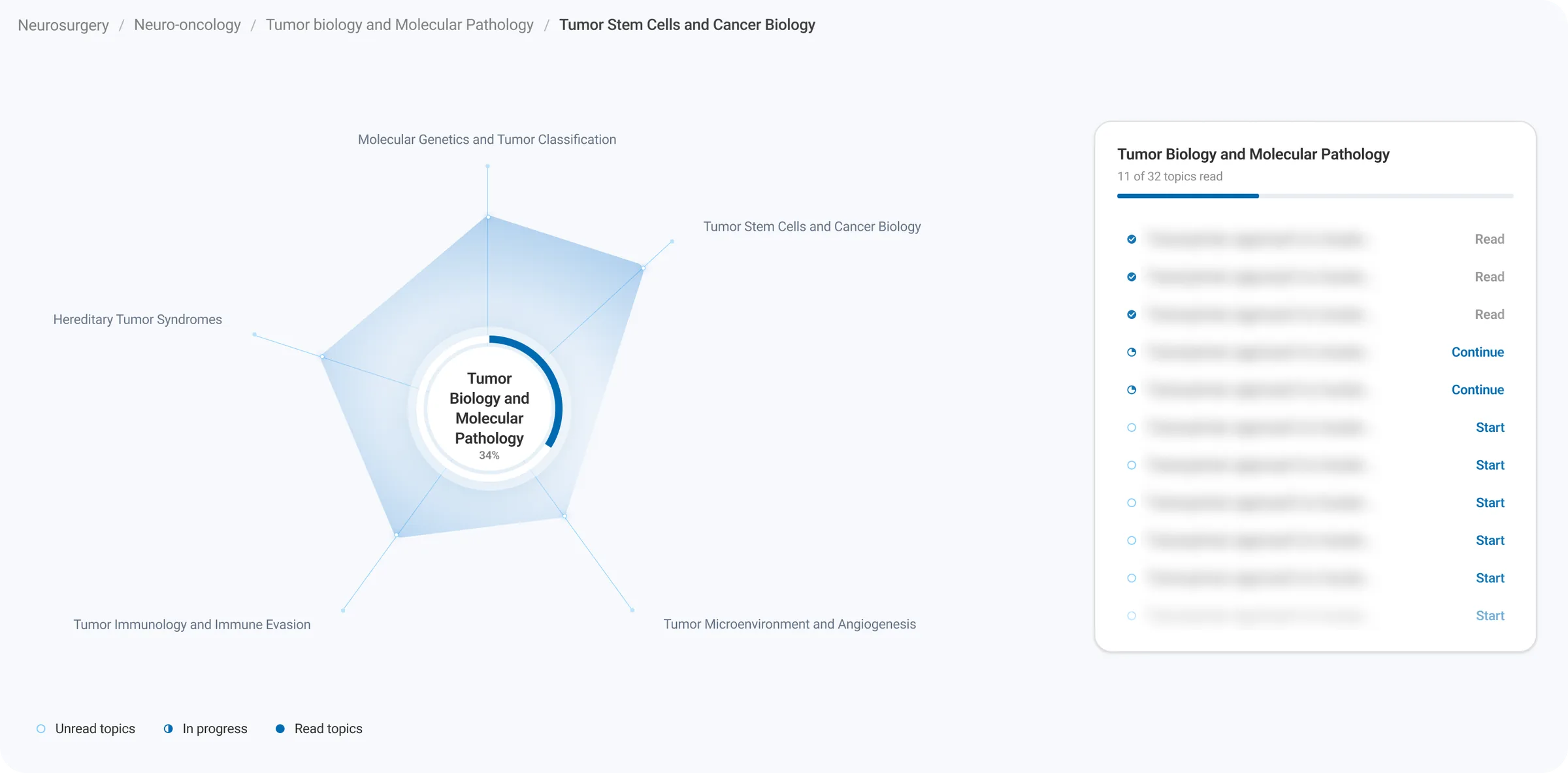
Screenshot from a demo account; topic titles blurred. Tap to enlarge.
A tree makes you remember the path. A map shows the whole area at once: your progress in the centre and every topic marked read, in progress or unread.
Suggested maps cover most of the more than 50 specialties Elumity lists, with the aim of covering all of them, and each map is a starting point, not an official curriculum. For each topic you keep one card. Write what you know first, then add the guideline, key papers and links to your department’s documents, and extract key points from your uploaded PDFs by hand or with AI grounded in those documents. The coverage view marks every topic as unread, in progress or read, and shows your progress as a percentage and in the shape of the spider map, so the areas you have covered and the blanks are visible at a glance. Writing from memory first and then checking the source turns each card into a small test rather than a tick. That is what we mean by “Your mind, extended”: the cards hold the structure, sources and dates, your head still does the knowing, and your notes outlive the edition.
“What’s new to you” (the product calls it the Knowledge Delta Engine) matches new papers against what you already hold on each topic, so what reaches you is what’s new to you rather than everything that’s new. A guideline published in a journal arrives like any other paper, which is how a change like 28 August can reach you. Treat the alert as a retrieval cue: recall what your card says, then open the paper.
It flags; you decide. Here is what it doesn’t do:
- Know you on day one. The map knows the specialty, not you.
- See everything that changes. “New to you” sees published papers, so a congress late-breaker arrives with the paper, while safety letters, guidelines published only on a society’s website and SOP updates still reach you through their usual channels.
- Make you an expert. A card or a “read” mark means you’ve worked through a topic, not mastered it. Retrieving from memory and noting versions stay your habits, and spaced repetition stays in your flashcard app or your head, because your own brain must stay your primary knowledge base.
- Act as a clinical or regulatory system. It is not a guideline source, clinical decision tool, validated GxP system or formal training record (your logbook or portfolio stays that), and we don’t claim CME accreditation. Check AI drafts against their sources and keep patient data off your cards.
Everything sits in the same tool: the specialty map with suggested topics, cards for your own notes, sources and documents, AI grounded in your uploads, PubMed and OpenAlex references, “what’s new to you” and group spaces for working on topics together. It’s fair to ask whether a self-funded start-up will be here in three years, which is why your own files and cards always stay accessible to you and export with one click.
For a programme, practice or L&D team, Elumity adds a curriculum feed with monitoring and reporting. Trainers and managers see aggregated figures for their team, not anyone’s individual progress or data. The one exception is content they mark as mandatory, where personal progress statistics are shown, so agree that list with your works council or employee representatives before you start (and remember that in a team of three, an aggregate can still point to one person).
Your data-protection officer will ask the rest first, so here are the answers. Data is hosted in Switzerland, uploads don’t train AI models, and a trainee’s cards, files and notes are visible only to that trainee. When you cancel, you can export all the content you uploaded, and deleting the account in the app deletes your data. Elumity complies with the Swiss Data Protection Act (DSG) and the GDPR; for anything else, write to us. The notes above cover the rest of your setting.
Nobody fills a specialty in a weekend, and you don’t have to. If you ran the 10-minute check, you already have your first five cards: topic, source, version, date and your verdict. They work on paper too, and there is nothing to migrate: your books and pencil notes stay where they are, and a new card can start whenever a topic next comes up. If you’d rather keep them in one place, put them into Elumity, from memory first, and see whether the habit sticks.
So, should you still buy medical textbooks?
Yes, for what they do best: the deep reading that builds a stable understanding of how the body works. They are outdated in places, not wrong. What they can’t do any more are the other two jobs: telling you what’s current and remembering what you know. (If you’re weighing books against bite-sized digital learning more broadly, our earlier piece on learning from textbooks to microlearning goes further.)
The heart-failure chapter on your shelf is still a fine explanation of a failing heart. It can’t tell you that one of its categories disappeared on a Friday in August, which of its other pages moved last year or what you already know. Run the check on five topics tonight, and you’ll know whether any of yours moved. Date the sheet and run the same five again in April 2027, when we recheck this post.
Notes
- Written for healthcare professionals; not clinical advice. The list of changes summarises definitions and headline decisions only. Classes of recommendation, transitional rules and national adoption are in the source documents.
- Issuing bodies by country (for step 2): Germany: AWMF, NVL, DEGAM, specialty societies (for cardiology, the DGK Pocket-Leitlinien), STIKO, BfArM and PEI, Rote-Hand-Briefe. Austria: specialty societies, NIG, BASG. Switzerland: specialty societies, BAG and EKIF, Swissmedic. Netherlands: NHG, FMS Richtlijnendatabase, CBG and Lareb. UK: NICE, BNF and BNFC, Resuscitation Council UK, the Green Book, MHRA. US: ACC/AHA, ACR, USPSTF, CDC vaccine schedules, FDA labels. Europe: ESC, ERC, ESMO, EAN, ESO, ESR, EMA.
- The lag is old: in 1992, Antman and colleagues found that most textbook chapters and review articles did not recommend thrombolysis until 13 years after pooled trials could have shown it saved lives.[35]
- Older studies: Antman 1992, Shekelle 2001, Davis 2006, Larsen 2009, Bergman 2010, Jeffery 2012, Prasad 2013, Del Fiol 2014 and the 2021 German survey use data that are years old. They are cited because they remain the best measurements of their kind.
- US blood pressure: the 2025 AHA/ACC guideline kept the categories of its 2017 predecessor, so in the US hypertension starts at 130/80, against 140/90 in Europe.[36]
- PubMed counts: searches by publication date can count a record in two adjacent years (print and online), so daily figures are approximate.
- Review: sources checked 29 October 2026; next review April 2027.
References
[1] Køber L, Adamo M, et al. 2026 ESC Guidelines for the management of heart failure. Eur Heart J. 2026;47(38):5346–5457. Published online 28 Aug 2026. https://doi.org/10.1093/eurheartj/ehag100
[2] Mills NL, Newby LK, Zaman S, et al. Fifth Universal Definition of Myocardial Infarction (2026). Eur Heart J. 2026;47(40):5911–5958. Published online 28 Aug 2026. https://doi.org/10.1093/eurheartj/ehag101
[3] Loscalzo J, Fauci AS, Kasper DL, et al., eds. Harrison’s Principles of Internal Medicine. 22nd ed. McGraw Hill; 2025 (previous editions 2022 and 2018).
[4] Herold G, et al. Innere Medizin 2026. Elsevier; published 6 February 2026. ISBN 978-3-437-41548-7
[5] Prasad V, Vandross A, Toomey C, et al. A decade of reversal: an analysis of 146 contradicted medical practices. Mayo Clin Proc. 2013;88(8):790–798. https://doi.org/10.1016/j.mayocp.2013.05.012
[6] PubMed (US National Library of Medicine). Records with publication date 2025 (“2025[dp]”): about 1,881,000; 2015 (“2015[dp]”): about 1,258,000; records created in 2025 (“2025[crdt]”): 1,710,319; searched 29 October 2026. https://pubmed.ncbi.nlm.nih.gov/
[7] Del Fiol G, Workman TE, Gorman PN. Clinical questions raised by clinicians at the point of care: a systematic review. JAMA Intern Med. 2014;174(5):710–718. https://doi.org/10.1001/jamainternmed.2014.368
[8] McEvoy JW, McCarthy CP, Bruno RM, et al. 2024 ESC Guidelines for the management of elevated blood pressure and hypertension. Eur Heart J. 2024;45(38):3912–4018. https://doi.org/10.1093/eurheartj/ehae178
[9] European Medicines Agency. Leqembi (lecanemab): EPAR, EU marketing authorisation 15 April 2025. Kisunla (donanemab): EPAR, EU marketing authorisation 24 September 2025. https://www.ema.europa.eu/en/medicines/human/EPAR/leqembi · https://www.ema.europa.eu/en/medicines/human/EPAR/kisunla
[10] European Medicines Agency. Potential risk of neurodevelopmental disorders in children born to men treated with valproate medicines: PRAC recommends precautionary measures. 12 January 2024. https://www.ema.europa.eu/en/news/potential-risk-neurodevelopmental-disorders-children-born-men-treated-valproate-medicines-prac-recommends-precautionary-measures
[11] Delgado P, Vargas C, Ackerman R, Salmerón L. Don’t throw away your printed books: a meta-analysis on the effects of reading media on reading comprehension. Educ Res Rev. 2018;25:23–38. https://doi.org/10.1016/j.edurev.2018.09.003
[12] World Health Organization. ICD-11 for Mortality and Morbidity Statistics: 6D10 Personality disorder. In effect from 1 January 2022. https://icd.who.int/
[13] Martínez García L, Sanabria AJ, García Álvarez E, et al. The validity of recommendations from clinical guidelines: a survival analysis. CMAJ. 2014;186(16):1211–1219. https://doi.org/10.1503/cmaj.140547
[14] Ponikowski P, Voors AA, Anker SD, et al. 2016 ESC Guidelines for the diagnosis and treatment of acute and chronic heart failure. Eur Heart J. 2016;37(27):2129–2200. https://doi.org/10.1093/eurheartj/ehw128
[15] McDonagh TA, Metra M, Adamo M, et al. 2021 ESC Guidelines for the diagnosis and treatment of acute and chronic heart failure. Eur Heart J. 2021;42(36):3599–3726. https://doi.org/10.1093/eurheartj/ehab368
[16] Shekelle PG, Ortiz E, Rhodes S, et al. Validity of the Agency for Healthcare Research and Quality clinical practice guidelines: how quickly do guidelines become outdated? JAMA. 2001;286(12):1461–1467. https://doi.org/10.1001/jama.286.12.1461
[17] US Food and Drug Administration. Artificial Intelligence-Enabled Medical Devices (content current as of 22 September 2026). https://www.fda.gov/medical-devices/digital-health-center-excellence/artificial-intelligence-enabled-medical-devices
[18] Kobak D, González-Márquez R, Horvát EÁ, Lause J. Delving into LLM-assisted writing in biomedical publications through excess vocabulary. Sci Adv. 2025;11(27):eadt3813. https://doi.org/10.1126/sciadv.adt3813
[19] Densen P. Challenges and opportunities facing medical education. Trans Am Clin Climatol Assoc. 2011;122:48–58. PMID 21686208. https://pubmed.ncbi.nlm.nih.gov/21686208/
[20] Bornmann L, Haunschild R, Mutz R. Growth rates of modern science: a latent piecewise growth curve approach to model publication numbers from established and new literature databases. Humanit Soc Sci Commun. 2021;8:224. https://doi.org/10.1057/s41599-021-00903-w
[21] Bernstein E, Bhardwaj N, Pfoh ER, Yudelevich E. A nationwide survey of educational resource utilization and perception among internal medicine residents. J Gen Intern Med. 2021;36(6):1598–1604. https://doi.org/10.1007/s11606-020-06441-6
[22] Jeffery R, Navarro T, Lokker C, et al. How current are leading evidence-based medical textbooks? An analytic survey of four online textbooks. J Med Internet Res. 2012;14(6):e175. https://doi.org/10.2196/jmir.2105
[23] Omar M, Sorin V, Collins JD, et al. Multi-model assurance analysis showing large language models are highly vulnerable to adversarial hallucination attacks during clinical decision support. Commun Med. 2025;5:330. https://doi.org/10.1038/s43856-025-01021-3
[24] Davis DA, Mazmanian PE, Fordis M, et al. Accuracy of physician self-assessment compared with observed measures of competence: a systematic review. JAMA. 2006;296(9):1094–1102. https://doi.org/10.1001/jama.296.9.1094
[25] Marburger Bund. MB-Barometer Ärztliche Weiterbildung 2021 (n = 3,238). 28 October 2021. https://www.marburger-bund.de/sites/default/files/files/2021-10/MB-Barometer-Weiterbildung_2021_Ergebnisse-Zusammenfassung.pdf
[26] VSAO. Mitgliederbefragung 2023, Management Summary (n = 3,180). DemoSCOPE; 2023. https://vsao.ch/wp-content/uploads/2023/05/Mitgliederbefragung-VSAO-2023-Management-Summary_DE_final.pdf
[27] Marburger Bund, IQME. MB-Monitor 2024: Gesamtauswertung (n = 9,649). 2025. https://www.marburger-bund.de/sites/default/files/files/2025-02/Gesamtauswertung%20IQME%20%E2%80%93%20MB-Monitor%202024_Website.pdf
[28] Clark A, Chalmers D. The extended mind. Analysis. 1998;58(1):7–19. https://doi.org/10.1093/analys/58.1.7
[29] Larsen DP, Butler AC, Roediger HL. Repeated testing improves long-term retention relative to repeated study: a randomised controlled trial. Med Educ. 2009;43(12):1174–1181. https://doi.org/10.1111/j.1365-2923.2009.03518.x
[30] Bergman O, Whittaker S, Sanderson M, Nachmias R, Ramamoorthy A. The effect of folder structure on personal file navigation. J Am Soc Inf Sci Technol. 2010;61(12):2426–2441. https://doi.org/10.1002/asi.21415
[31] Schroeder NL, Nesbit JC, Anguiano CJ, Adesope OO. Studying and constructing concept maps: a meta-analysis. Educ Psychol Rev. 2018;30(2):431–455. https://doi.org/10.1007/s10648-017-9403-9
[32] Karpicke JD, Blunt JR. Retrieval practice produces more learning than elaborative studying with concept mapping. Science. 2011;331(6018):772–775. https://doi.org/10.1126/science.1199327
[33] Blunt JR, Karpicke JD. Learning with retrieval-based concept mapping. J Educ Psychol. 2014;106(3):849–858. https://doi.org/10.1037/a0035934
[34] Directive 2001/83/EC of the European Parliament and of the Council of 6 November 2001 on the Community code relating to medicinal products for human use, Articles 87 and 92. OJ L 311, 28.11.2001, p. 67–128. https://eur-lex.europa.eu/eli/dir/2001/83/oj
[35] Antman EM, Lau J, Kupelnick B, Mosteller F, Chalmers TC. A comparison of results of meta-analyses of randomized control trials and recommendations of clinical experts: treatments for myocardial infarction. JAMA. 1992;268(2):240–248. https://doi.org/10.1001/jama.1992.03490020088036
[36] Jones DW, Ferdinand KC, Taler SJ, et al. 2025 AHA/ACC/AANP/AAPA/ABC/ACCP/ACPM/AGS/AMA/ASPC/NMA/PCNA/SGIM guideline for the prevention, detection, evaluation and management of high blood pressure in adults. Hypertension. 2025;82(10). Published online 14 Aug 2025. https://doi.org/10.1161/HYP.0000000000000249